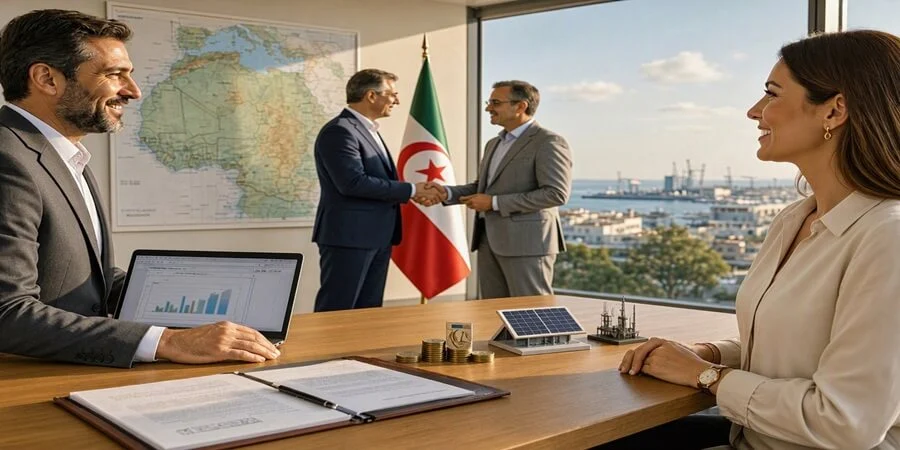
Investing in Algeria looks confusing for foreign businesses. Even after the new investment law and the end of the 51/49 rule, foreign investors still report delays, heavy paperwork and unexpected requirements. There is a simple reason: Algeria earns most of its foreign currency from oil and gas, so it watches every dollar and euro that leaves the country very closely. Once you understand that one idea, the rest of the system makes sense. This guide shows how to invest in Algeria by working with that logic instead of against it, and how to structure your entry so it plays in your favor.
Doing business in Algeria is neither easy nor closed, and this guide will not pretend otherwise. It will show you which kind of investor the system is designed to welcome, and how to structure your entry so you are that investor.
The question that decides everything: where does your hard currency come from?
Algeria’s trade minister said in early 2026 that hydrocarbons still make up roughly 91% of the country’s exports. That single fact explains most of what foreign investors experience. Hard currency enters the economy mostly through oil and gas, and every dividend, royalty or loan repayment sent abroad draws on that same pool. The central bank therefore reads every outbound transfer as a claim on a scarce resource.
Seen this way, the rules become consistent. Under Law 22-18, foreign currency contributions must be declared and registered with the Banque d’Algérie to qualify for the guarantee that lets you transfer capital and income out. Importing goods for resale as they are sits outside that guarantee, because it consumes currency without creating any. One 2026 analysis also reports a minimum foreign share of around 25% of the project cost for repatriation rights, a threshold worth confirming with counsel before you size your equity.
The practical reframe is simple. Stop asking “Can I get my money out?” and start asking “Does my project bring currency in, save currency that would otherwise be spent on imports, or earn currency from exports?” An investor who can answer yes to one of those is aligned with the system’s own incentives. An investor who cannot will spend years negotiating against it.
Foreign investment in Algeria after 2022: what changed, and what did not
The headline reform is real. Since the 2020 supplementary finance law and the investment law of 24 July 2022, foreign investors can hold up to 100% of the equity in most sectors, including agri-food, construction and telecommunications, without a local partner. What remains is more specific than most summaries suggest:
- Strategic sectors and activities touching national sovereignty still carry restrictions, and the 51/49 logic survives for import-for-resale activities.
- The mining framework is moving. A draft raising permitted foreign participation from 49% to 80% was still not in force in mid-2025, so check its current status before you plan around it.
- The law replaced a confusing patchwork of incentives with three clear regimes, and it reaffirmed the transfer guarantee, a stabilization mechanism for long-term investments, and access to international arbitration.
- Investors in production of goods and services, foreign or national, can now apply for state-owned land, which is often the most valuable incentive in practice.
- The Algerian Investment Promotion Agency (AAPI) acts as the single window for registration, replacing the maze of separate counters.
One more date matters. The Finance Law 2026 was signed on 14 December 2025 and took effect on 1 January 2026, adjusting withholding rates, permanent establishment rules and reporting duties. Any shareholder agreement or supply contract drafted before 2026, particularly its tax gross-up and indemnity clauses, deserves a second reading.
The overlooked play: build in Algeria, sell to Africa
Most foreign investors look at Algeria as a domestic market of nearly 48 million people. That is a legitimate strategy, but it is also the most crowded one and the one most exposed to import controls and currency rationing. The less obvious play is to treat Algeria as a production base for African customers.
The state is building toward this. In April 2026 it staged a coordinated export drive in which Tindouf sent 33 shipments to Mauritania involving ten operators, carrying construction materials, foodstuffs, plastics and household goods. A free trade zone is planned there, tied to the 847 kilometre road linking Tindouf to Zouerate in Mauritania. In January 2026 Algeria also joined the AfCFTA Guided Trade Initiative, and it has opened permanent showrooms for Algerian products in Mauritania and Senegal. Non-hydrocarbon exports reached a record of about $7 billion in 2022.
An honest caveat belongs here. Academic work on the subject is more sceptical than official speeches. A 2024 study concluded that Algeria still lacks some prerequisites for deep integration into African markets, and that many non-hydrocarbon products would not see gains from tariff cuts alone. Treat the Africa-facing model as a strong option with upside, not as the base case in your financial model.
The new discipline of export proceeds
If you export from Algeria, one recent change deserves attention. Regulation 26-02 of the Banque d’Algérie, dated 23 July 2026, tightened the rules on foreign currency from non-hydrocarbon exports. Proceeds must be repatriated on the day the non-resident customer pays. When you grant payment terms between 120 and 180 days, the export must be backed in advance by export credit insurance from the authorised national body, and the payment term must be written into the commercial contract.
The lesson is not that exporting got harder. It is that exporting rewards operators who run clean contracts. Price the insurance into your margins, negotiate payment terms before shipping rather than after, and keep your documentation airtight.
Three plays that fit the system
These are my reading of how the rules and the state’s priorities line up, not an official classification.
Replace an import. Every product Algeria currently buys abroad is currency the state would prefer to keep. Agriculture, irrigation, farm machinery and agro-industry are explicitly cited as benefiting from tax exemptions and land concessions under the investment law. A local factory that substitutes for imports solves the state’s problem before it solves yours.
Build an Africa-facing platform. Manufacture or process in Algeria and ship to Mauritania, Senegal and the wider Sahel using the new corridors. This earns the currency that keeps your own transfers smooth, and it positions you ahead of the logistics infrastructure still under construction.
Serve the big builds. The Gara Djebilet iron ore project, the Trans-Saharan Road and the planned gas and fibre links create demand for engineering, equipment, materials and services around them. The entry ticket is lower than for a standalone factory, but your counterparty is often the state, so payment cycles need careful contracting.
Doing business in Algeria: the mistakes that cost foreign businesses the most
- Treating documents as a formality. Analysts note that limits on repatriation are mostly procedural. The right exists, but transfers stall or get rejected when the file is incomplete. Build a documentation chain from day one: contribution declaration, shareholder resolution, commercial register update, bank form, tax clearance where required.
- Disguising an import business as an investment. If your model is buying abroad and reselling locally, expect the restricted regime and no transfer guarantee.
- Modelling returns at an imaginary exchange rate. Legal repatriation happens at the official rate, so build your projections on that basis.
- Hiring a lawyer after structuring. The structure (branch, subsidiary or joint venture) drives your tax and transfer position. Decide it with Algerian counsel, not after.
- Choosing a local partner for the wrong reason. You no longer need one for legal ownership in most sectors. Choose one if you need relationships, land access or market knowledge, and write the value of that contribution into the agreement.
How to invest in Algeria: five questions to answer before you commit
- Does the project bring in, save or earn foreign currency, and can I show that on one page?
- Is my sector open to 100% foreign ownership, or does a strategic restriction apply?
- Which of the three incentive regimes fits, and have I confirmed it with AAPI?
- Have my contracts been reviewed against the Finance Law 2026 and the July 2026 export rules?
- If repatriation took longer than planned, would the business still be healthy?
If you can answer all five with confidence, you are not a hopeful outsider knocking on a door. You are the kind of investor Algeria’s own policy is trying to attract.
This article is for general information and is not legal or tax advice. Algerian regulations change quickly, so confirm current rules with qualified local counsel and the relevant authorities before investing.
Put your business in front of investors entering Algeria
Foreign companies do not succeed in Algeria alone. They rely on local lawyers, accountants, consultants, logistics providers, suppliers and manufacturers who understand how the system works. If you offer those services, investors researching the market should be able to find you.
Add your business to Afrikta and reach companies exploring opportunities across Africa, in English and in French.
Trusted advisors and service providers for investing in Algeria

MEBARKI Law Firm serves a diverse range of clients in a variety of industries (automotive, engineering, construction, pharmaceuticals, telecommunications, advertising, etc.). We also provide daily...

Founded in 2010, Allegorie group is the 1st Algerian group of communication consultants. Today, the group has more than 180 staff in all public relations...

GEODIS is a true growth partner to its clients, providing end-to-end solutions based on its know-how, infrastructure, processes, and information systems that ensure operational excellence...

ECOVIS Audit Algeria is involved in auditing, consulting and accounting and is a member of the ECOVIS INTERNATIONAL network. ECOVIS Audit Algeria is very attached...

HiveDigit manages your digital transformation and assists you in achieving your goals. We offer all of our knowledge in digital creations as part of an...